
The 5 Greatest Donruss Rated Rookie Classes, Ranked — and the Hall of Famers They Somehow Missed
Donruss hired a newspaper writer to pick twenty rookies a year and printed his guesses on cards. Forty years of that record, ranked — plus five things about Rated Rookies the hobby has wrong.
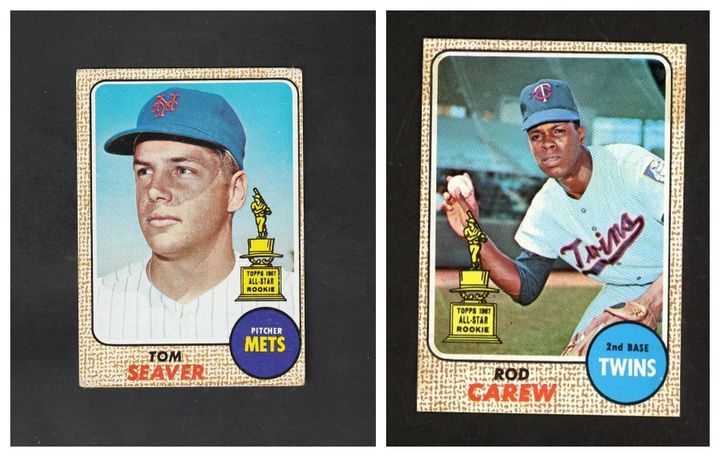
We ranked the ten best Topps All-Star Rookie classes a couple of days ago. The little gold cup ran for sixty-odd years and produced enough great classes to fill a top ten twice over.
The Rated Rookie doesn't. There are maybe seven years worth arguing about in the whole run, which is why this is a top five. Twenty cards a year, picked by a person, in advance, with no idea what was coming — and the record is much stranger than the logo's reputation suggests.
Two things to get straight before the countdown, because almost everything people repeat about this subset is wrong.
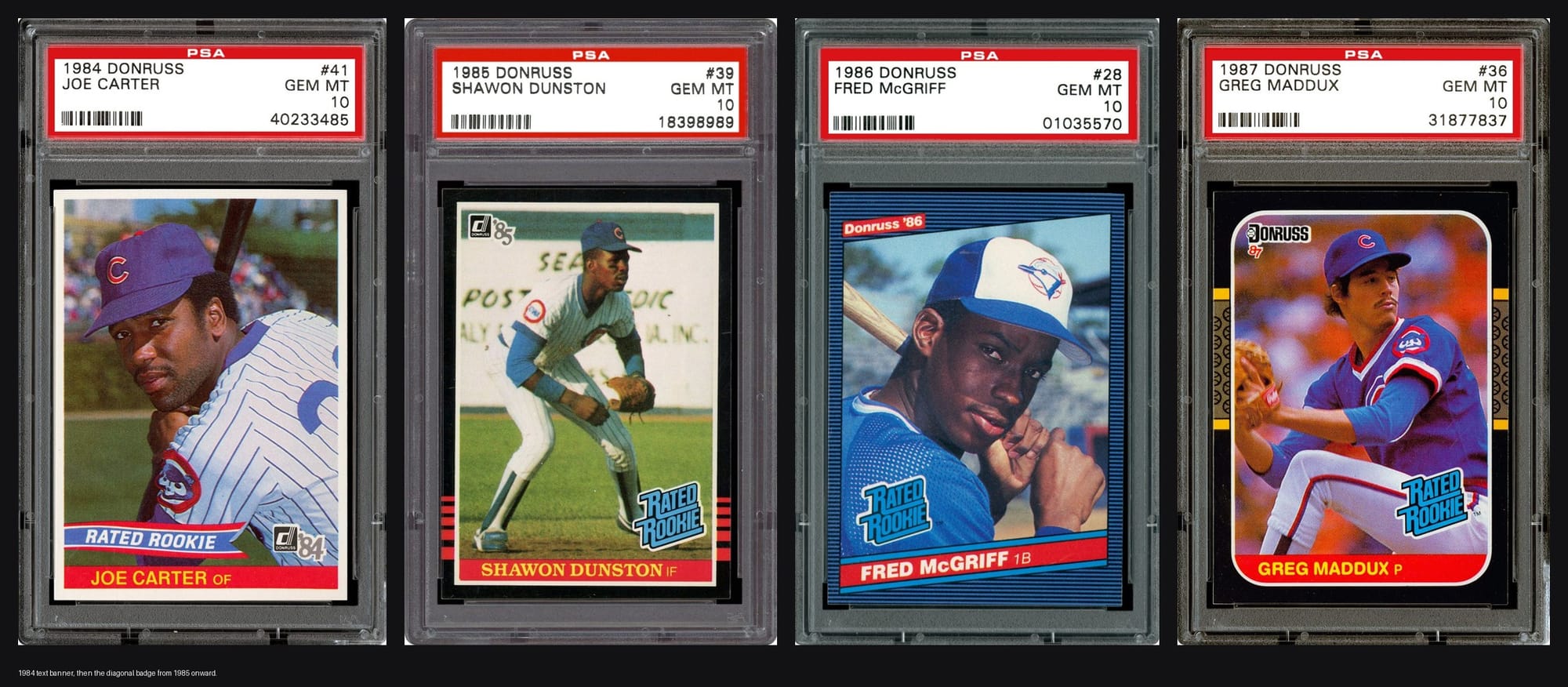
It didn't start in 1984, and the logo didn't either. The phrase "Rated Rookie" shows up first on the backs of 1983 Donruss cards — just a line of bold text, no designation on the front. The 1984 set is the first with an actual subset: twenty cards at #27–46, right behind the Diamond Kings, and Donruss hired a real person to choose them — Bill Madden of the New York Daily News. The 1984 cards used a text banner. The famous skewed baby-blue logo didn't arrive until 1985, and was trademarked that December. Panini has said the color was chosen specifically because it's team-neutral, far enough from every club's palette to stand out. And according to a former Donruss employee, the tilt was meant to look like a stock going up.
It was never a stable twenty. It was twenty from 1984 to 1990, forty across two series in 1991, forty-five in 1992 — when the Rated Rookies moved all the way to cards #1–20 because Diamond Kings had been pulled out of the base set — scattered with no block at all from 1993, gone entirely from baseball between 1998 and 2000, and back as about fifty serial-numbered cards in 2001.
We're ranking by two things: how much talent the class actually caught, and whether the cards are worth owning today. Those pull in opposite directions more often than you'd think.
First, the worst: 1985
You have to see the floor to appreciate the ceiling.
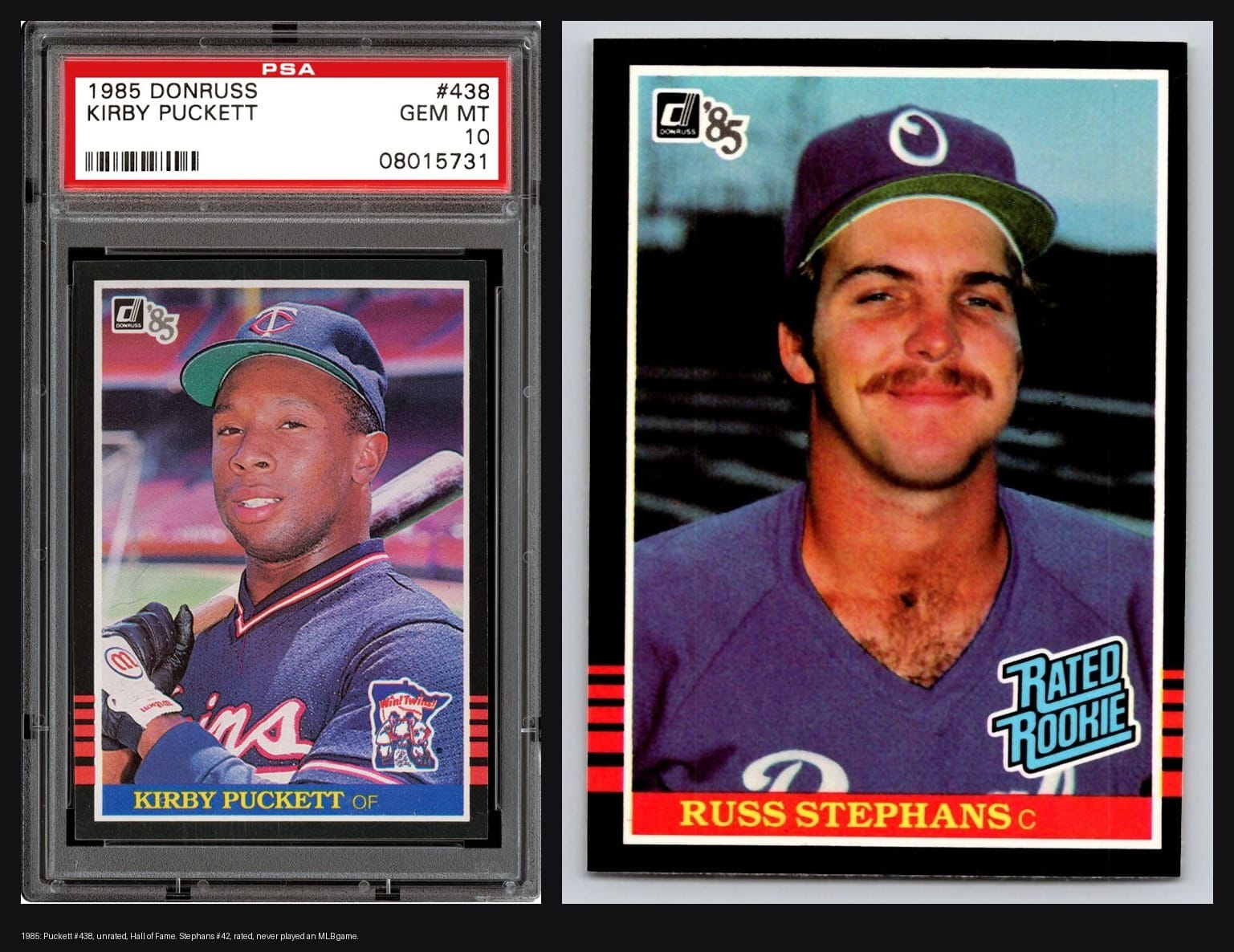
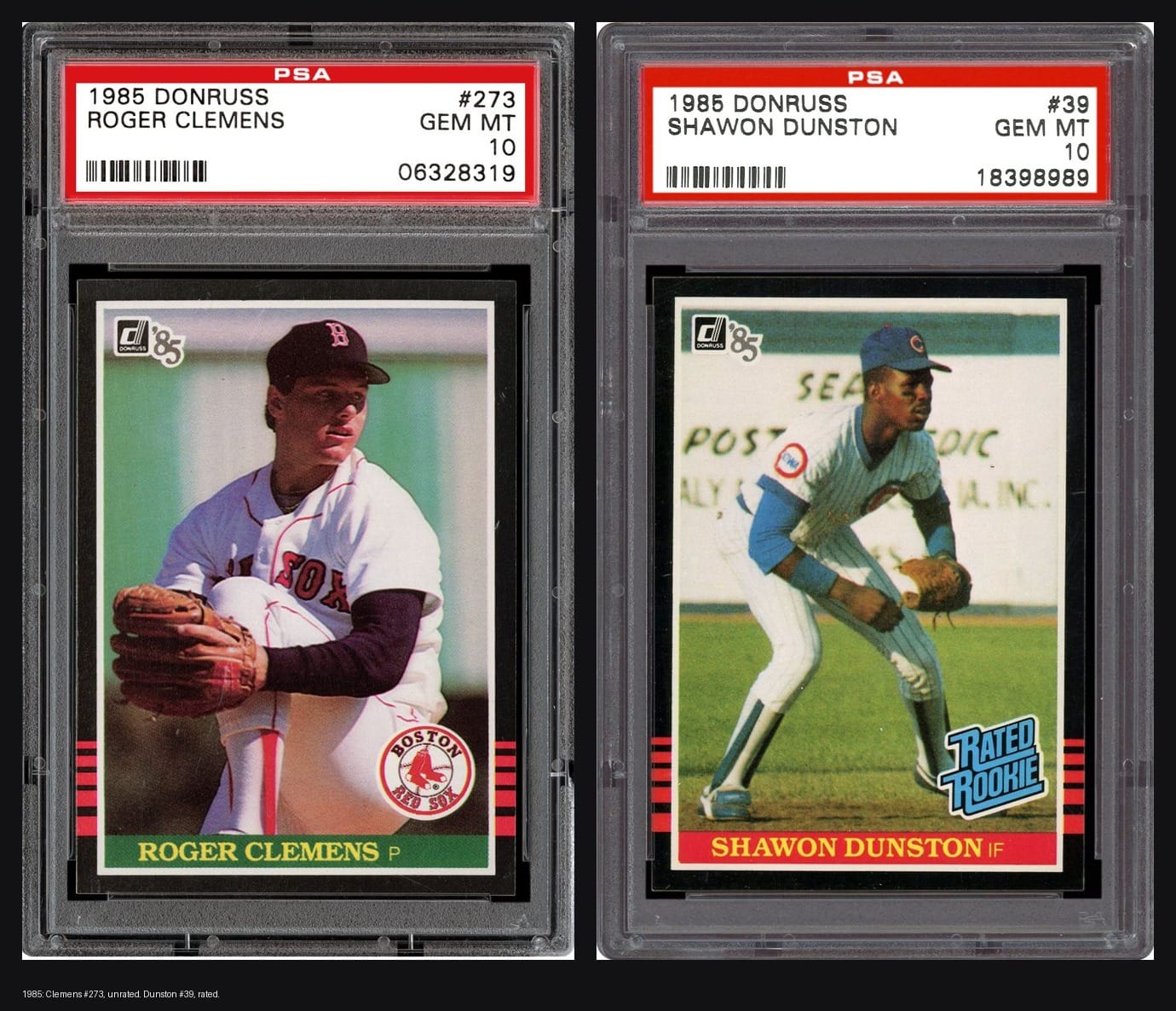
The 1985 Rated Rookie class — the first one with the real logo on it — is led by Danny Tartabull (#27) and Shawon Dunston (#39). After that it's Billy Hatcher, Steve Lyons, Larry Sheets. At #42 is Russ Stephans, a twenty-six-year-old catcher who never played a major league game in his life.
Now here's the part that hurts. Sitting in that same 1985 Donruss set, as ordinary base cards with no designation of any kind: Roger Clemens at #273. Kirby Puckett at #438. Also Dwight Gooden, Bret Saberhagen and Eric Davis.
Two first-ballot Hall of Famers in the set. Neither one rated. A guy who never reached the majors, rated.
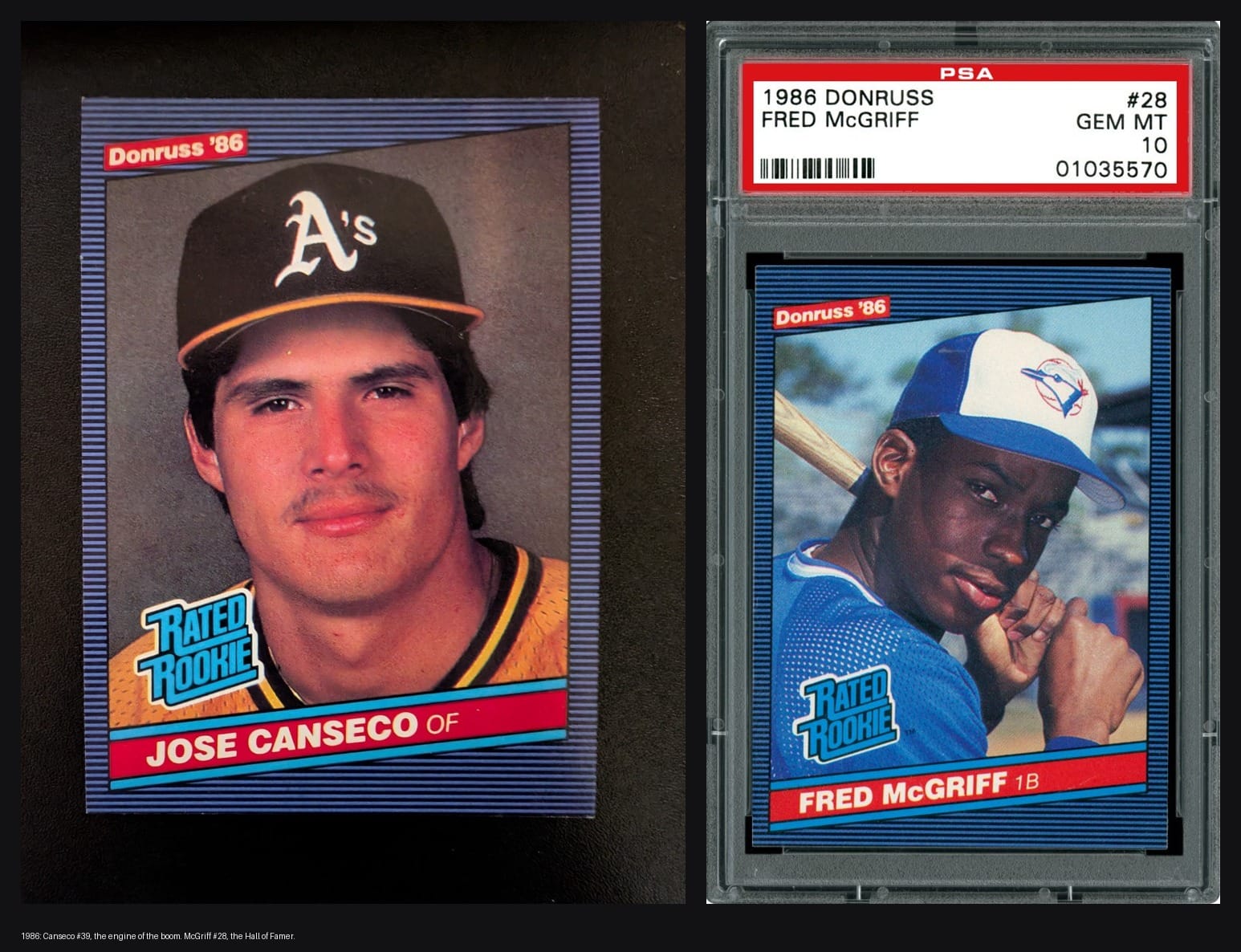
5. 1986 (#27–46)
Jose Canseco #39. Fred McGriff #28. Plus Andres Galarraga, Paul O'Neill, Todd Worrell and Cory Snyder.
Canseco's #39 was the engine of the entire late-eighties boom — the card everyone's older brother claimed to have pulled, the one shops put in the glass case, and one of the most counterfeited cards ever printed. It's worth somewhere between $370 and $880 in a PSA 10 depending on whether you trust the guides or the sales, which is a spread that tells you how strange this card's market still is.
McGriff supplies the plaque. He went into Cooperstown in 2023, thirty-seven years after Donruss put him at #28. Worth knowing: the #39 Canseco is a true rookie card because it's in the base set — the 1986 Donruss The Rookies and Fleer Update versions people also call rookies are technically XRCs.
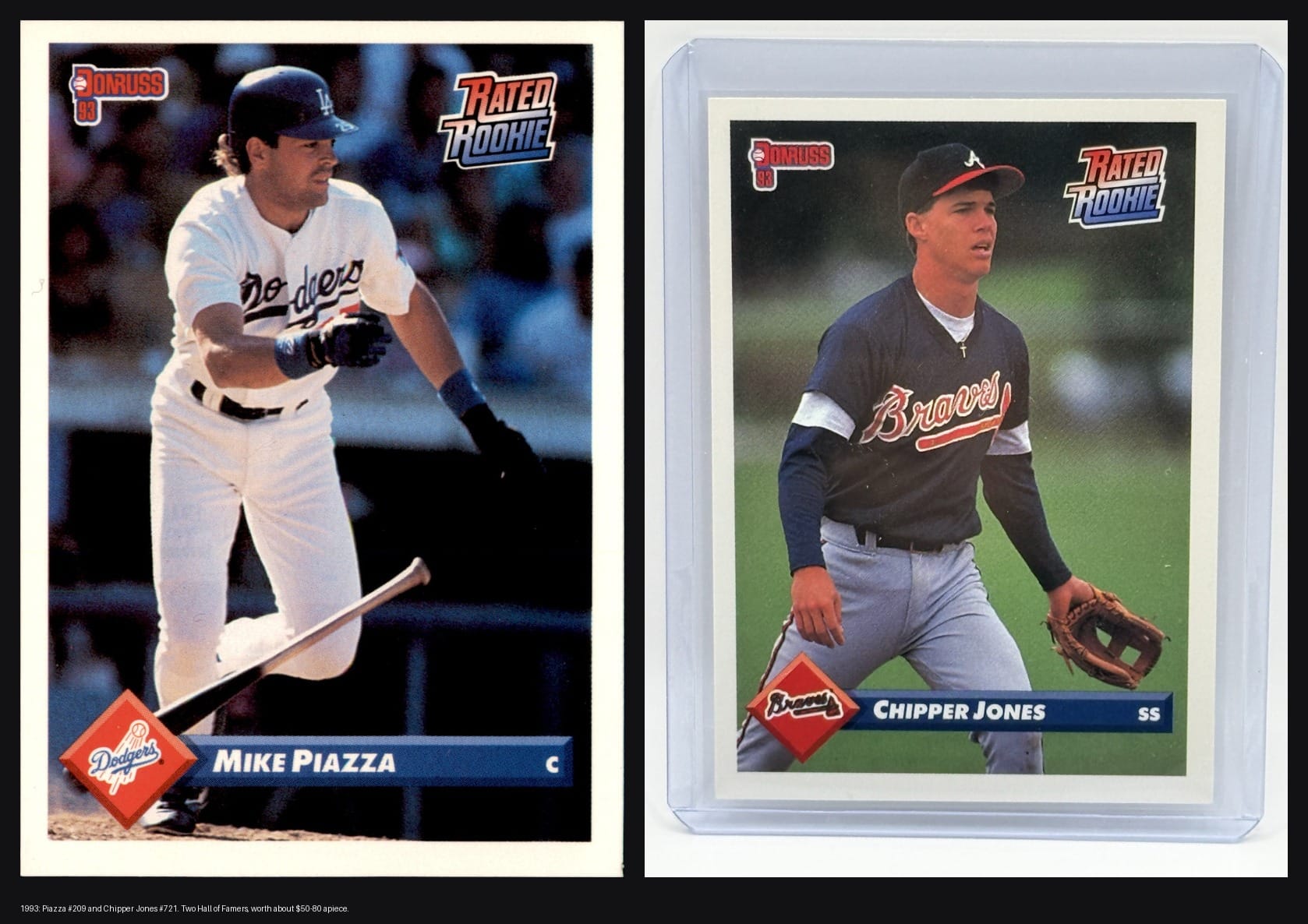
4. 1993 (scattered)
Mike Piazza #209. Chipper Jones #721. Plus Javy Lopez, Tim Salmon, Tim Wakefield, Bret Boone and J.T. Snow.
Two Hall of Famers and genuine depth behind them, and it's the last year of the classic blue logo before Donruss started redesigning it annually. A sixty-second-round catcher and a number one overall pick in the same class, both of whom made it.
It ranks fourth and not higher for one reason: the cards are worth nothing. Chipper's #721 runs about $78 in a PSA 10. Piazza's #209 is around $50. That's what the junk wax era did to the best class of the nineties — Donruss finally picked right and printed so many that being right didn't matter.
Also, 1993 is the year of the subset's most famous absence. There is no Derek Jeter Rated Rookie. There's no Jeter in 1993 Donruss at all, or 1994, or 1995 — the 1995 Donruss #491 that turns up on eBay as "Jeter Rated Rookie" is a pitcher named Joe Ausanio. Every listing you've seen is mislabeled.
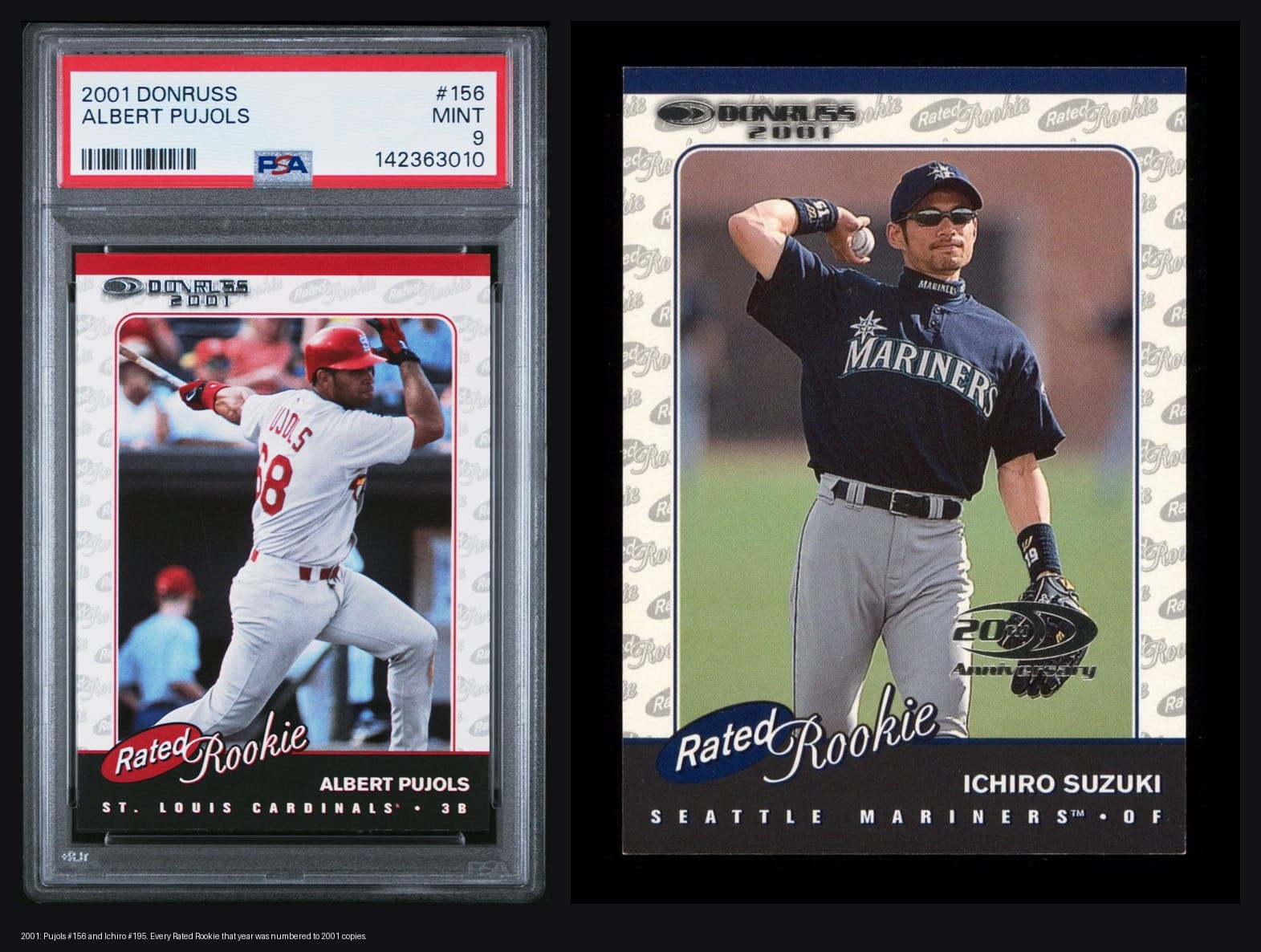
3. 2001 (#151–200)
Albert Pujols #156. Ichiro Suzuki #195. Plus Alfonso Soriano, Josh Beckett and Carlos Peña.
Two first-ballot Hall of Famers in a year Donruss called both correctly at the same time. But it's third instead of second because of something the other classes don't have: every Rated Rookie in 2001 is serial-numbered to 2001 copies. It's the only class on this list that isn't junk wax. If you want to actually own one of these, this is the year.
And #156 has a story that's worth more than the card. The slot wasn't supposed to be Pujols. It was supposed to be Brian Cole, a Mets outfield prospect who was killed in a car accident in spring training in 2001. Donruss pulled the card, and filled the hole with a Pujols redemption — 500 exchange cards seeded into packs, of which only about half were ever redeemed. Which means roughly 250 of the best Rated Rookies ever made were never claimed and are still, technically, out there.
2. 1987 (#28–47)
Greg Maddux #36. Mark McGwire #46. Bo Jackson #35. Rafael Palmeiro #43. And Benito Santiago at #31, who won Rookie of the Year that season.
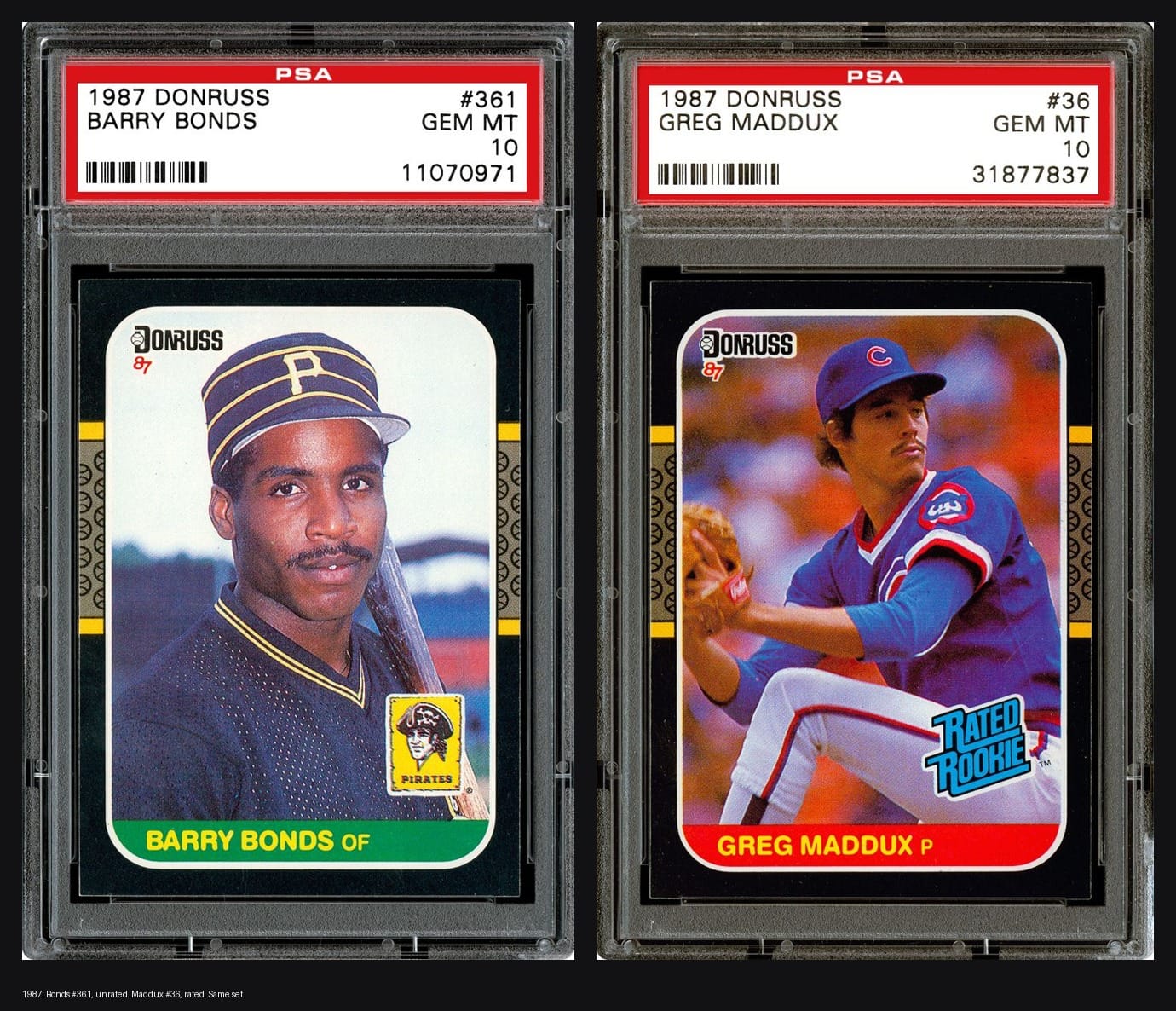
Four household names in one twenty-card block. Nothing else in the subset's history is that deep — two Hall of Famers, the man who hit seventy home runs, the only human being to make an All-Star team in two sports, and a 3,000-hit first baseman, all rated in advance, all in the same twenty cards. Maddux's #36 is the money card at roughly $300 to $600 in a PSA 10 depending on the day.
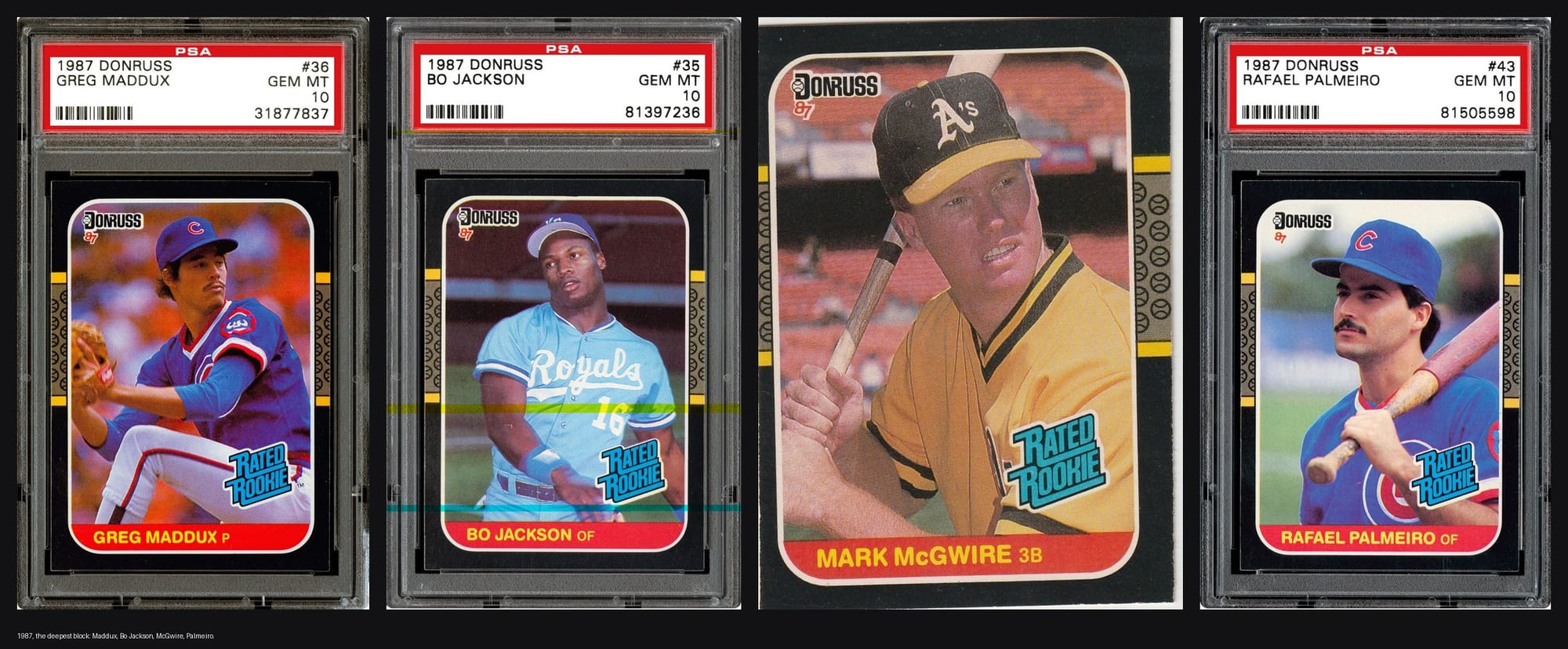
They still missed. Sitting in that same 1987 set as plain base cards: Barry Bonds at #361 and Will Clark at #66. Donruss got four megastars right in twenty tries and still let the all-time home run leader walk by. (One housekeeping note, since it comes up: McGwire's #46 is not cleanly "his rookie card" — the 1985 Topps Team USA #401 came first and is worth more.)
1. 1989 (#28–47)
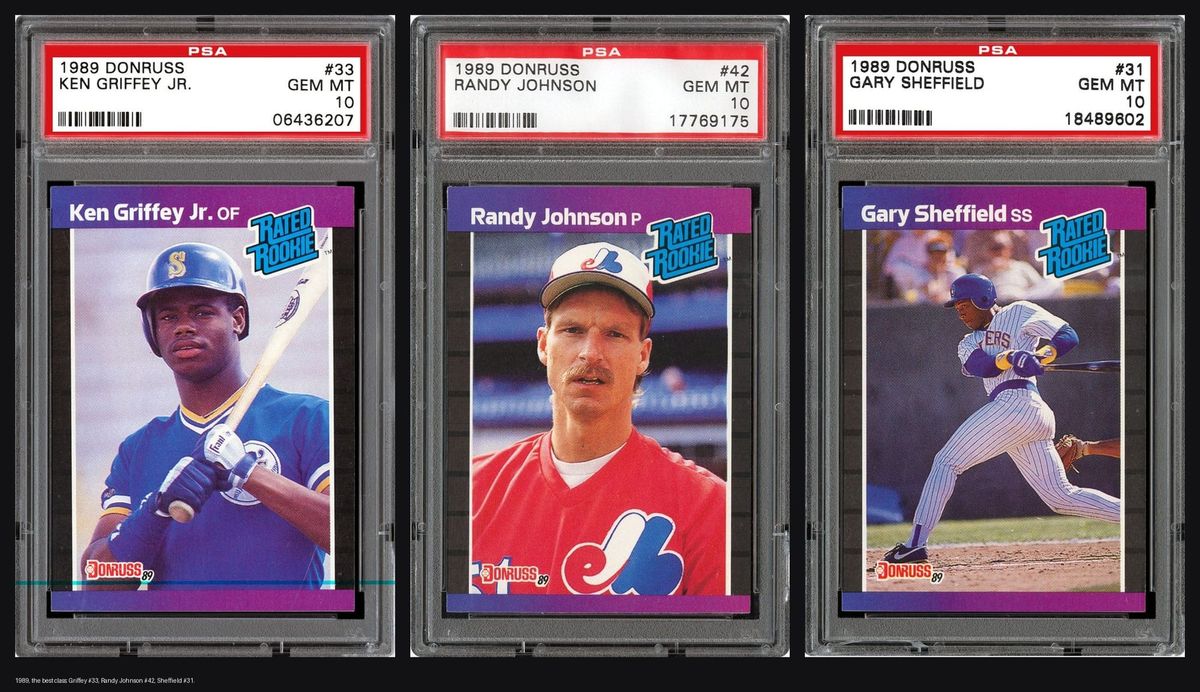
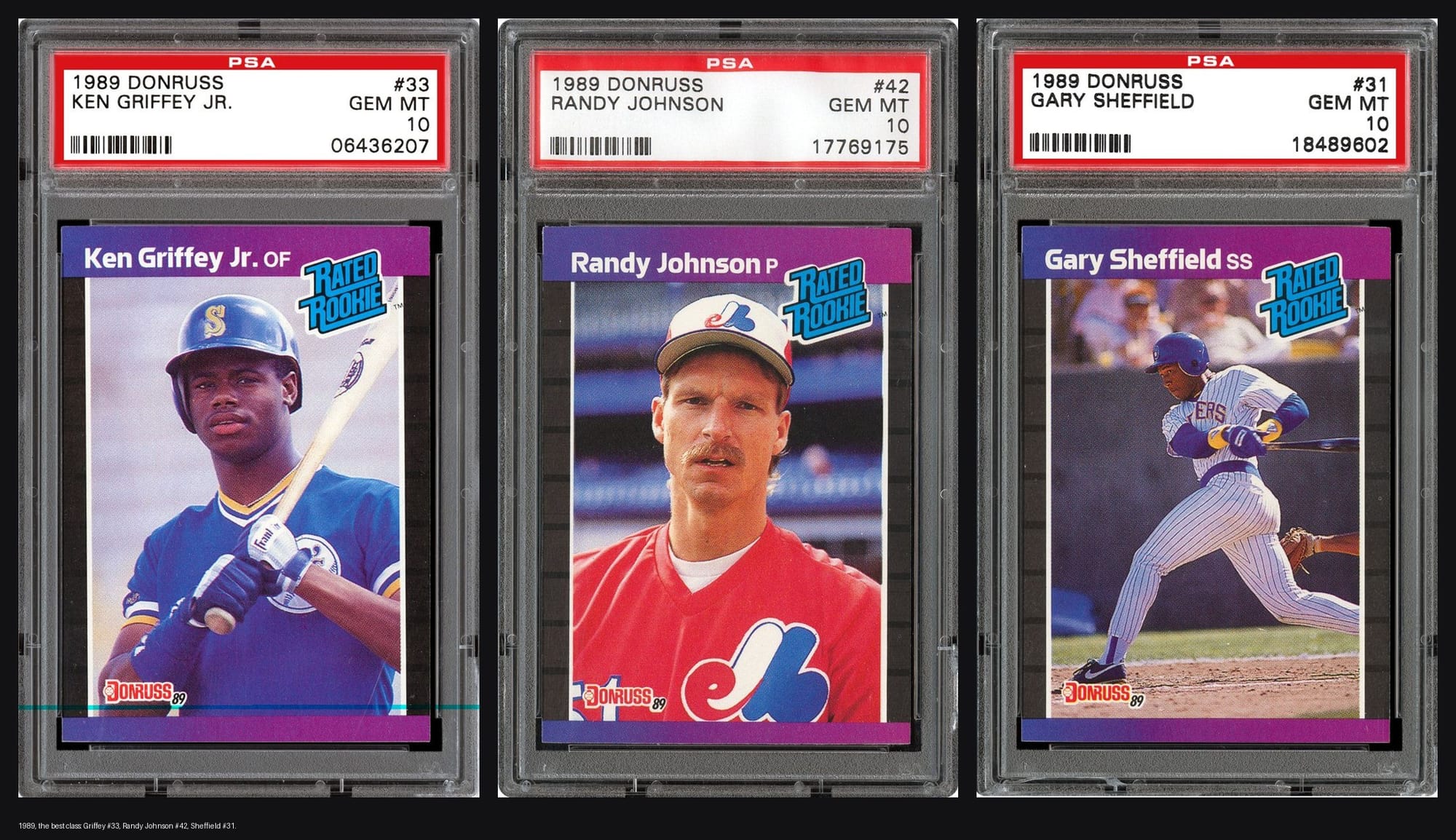
Ken Griffey Jr. #33. Randy Johnson #42. Gary Sheffield #31. Plus Sandy Alomar Jr., Gregg Olson, Tom Gordon and Gregg Jefferies.
Two inner-circle Hall of Famers and a man who hit 509 home runs, in one block of twenty cards, in the same year. That's the talent case, and it's enough on its own. Then there's the money case, and it's the one that settles the argument.
The Griffey #33 is the only Rated Rookie from the entire junk wax era that's actually worth real money — about $1,100 to $1,225 in a PSA 10 as of last month, and rising. Everything else printed between 1988 and 1994 is worth pocket change, because they were printing in the millions; 1991 Donruss ran something like three million copies of every single base card.
While we're here: the idea that Upper Deck #1 is Griffey's "only real rookie" is nonsense that's been repeated for thirty-five years. The Donruss #33, the Fleer #548, the Score #625, the Topps Traded #41T and the Bowman #220 are all true 1989 rookie cards. Upper Deck's is more desirable — $3,900 to $5,100 in a PSA 10 — not more legitimate.
1989 is also, as far as we can tell, the only year Donruss looked at a rookie class and correctly identified the best player in it.
Five Things Everyone Believes About Rated Rookies That Aren't True
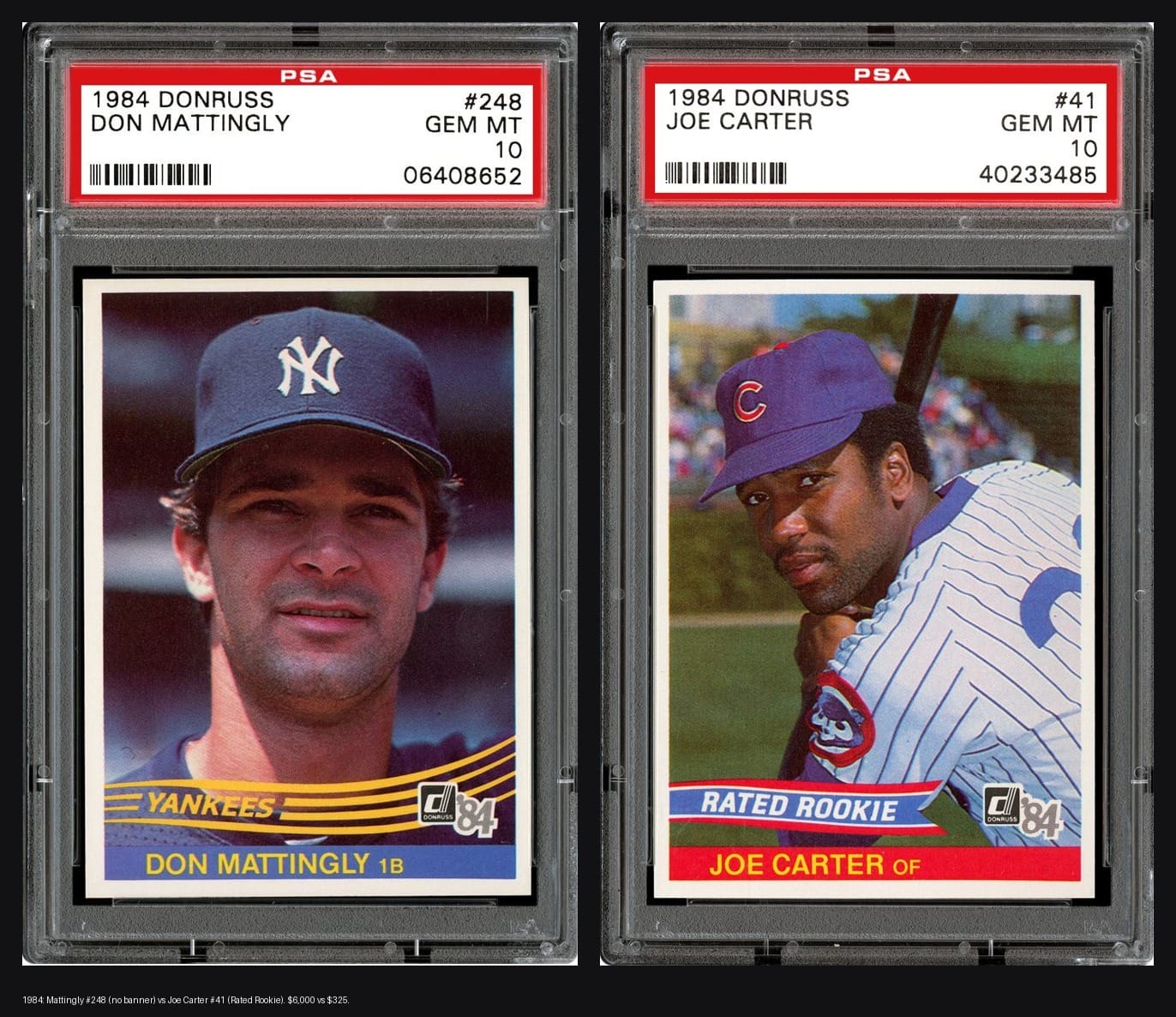
Don Mattingly is a 1984 Rated Rookie. He isn't. He's card #248, outside the block entirely. And here's the detail that makes it: Bill Madden, the writer Donruss hired to pick that first class, was the New York Daily News' Yankees beat writer. He watched Mattingly every day and left him off. Mattingly's #248 is worth about $6,000 in a PSA 10. The best card Madden did pick — Joe Carter at #41 — is worth $325.
Clemens and Puckett are 1985 Rated Rookies. Clemens is #273. Puckett is #438. Neither was rated.
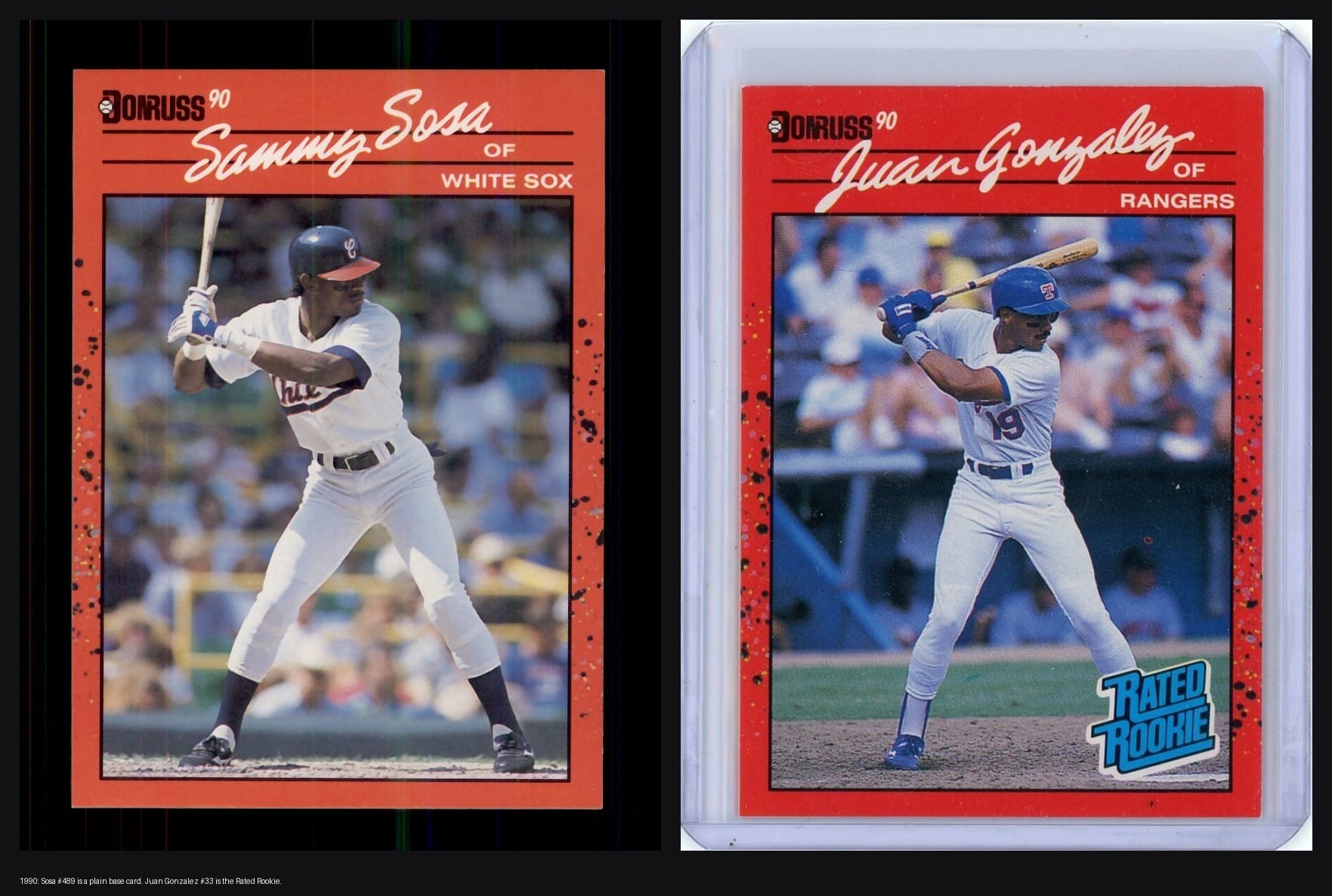
Sammy Sosa and Larry Walker are 1990 Rated Rookies. Sosa is #489, Walker is #578, both plain base cards. The 1990 Rated Rookie was Juan Gonzalez at #33.
Chipper Jones is a 1992 Rated Rookie. 1993, #721.
It was always twenty cards a year. It was twenty, then forty, then forty-five, then scattered, then nothing at all for three years, then fifty.
The Ones That Just Missed
1992 (#1–20 and #397–421): Jim Thome at #406 and Kenny Lofton at #5, plus Ryan Klesko — and at #9, Todd Van Poppel, the most famous bust the subset ever produced. 1988: Roberto Alomar #34, Mark Grace #40, Jack McDowell #47 — solid, one Hall of Famer, no stars. 1990: zero Hall of Famers, but the most valuable non-Griffey Rated Rookie of the era isn't a player at all, it's a mistake — the Juan Gonzalez #33 reverse negative runs $550 to $600 in a PSA 10 against $35 for the corrected version, which puts it in the same company as the great error cards. 1991: forty Rated Rookies and, in BaseballCardPedia's blunt phrasing, no notable rookie cards at all.
And the best bust in the run: Alex Sanchez, a Blue Jays right-hander, was rated in 1989 at #47 and again in 1990 at #45. Donruss looked at him twice. His entire major league career was one game, a 0–1 record, and a 10.03 ERA.
Which class did we rank wrong? Comments below.
Comments ()